“The RFC has rendered a great service to the American people, far greater than can be generally known. It has averted ruin and disaster for millions of our citizens.”
Jesse H. Jones, July 15, 1939
“The Act of June 25, 1940—which gave us the dictionary—authorized us to purchase plants, lease plants, build plants, whatever we wished, and in any way we might find feasible… It empowered the RFC to manufacture arms, to train aviators, to do almost anything else that would strengthen the nation’s armed might. We could buy or build anything the President defined as strategic or critical.”
Jesse H. Jones, Fifty Billion Dollars: My Thirteen Years with the RFC
“To define Jones’s responsibilities would be to list virtually every organization within the national government. Essentially… it is his job to finance the industrial plant expansion for waging war.”
LIFE magazine, October 5, 1942
2017 Houston Chronicle
Houston Reading Challenge Selection
2015 Julia Ideson
Honorable Mention Award
2013 San Antonio
Conservation Society Citation
2012 East Texas Historical Association
Ottis Lock Award
2011 Texas Institute of Letters
Carr P. Collins Award for
Best Non-Fiction Book
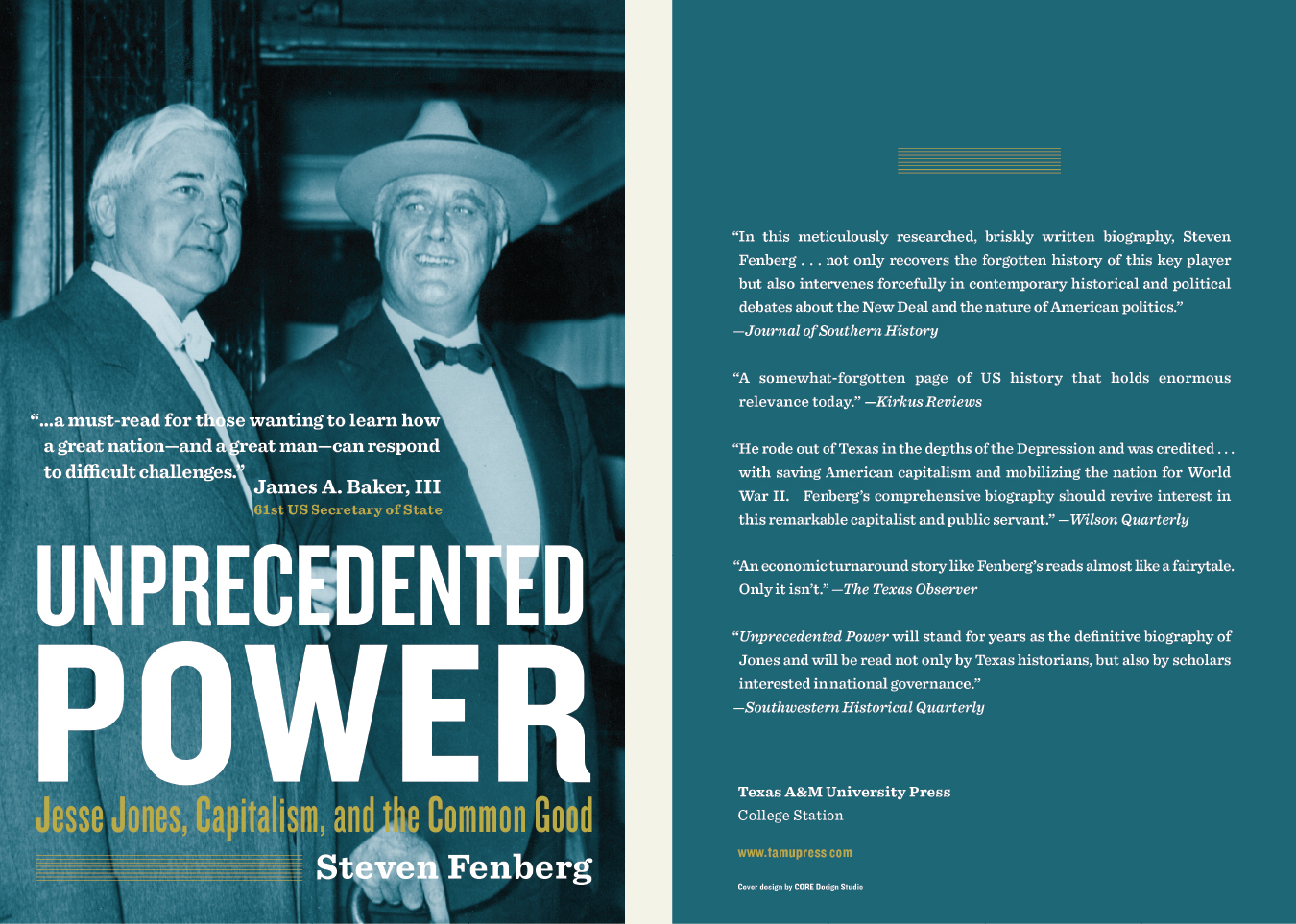
Unprecedented Power shows how during the depths of the Great Depression the Reconstruction Finance Corporation (RFC) and its chairman Jesse Jones rescued thousands of banks, businesses, homes and farms; stabilized the railroads; rebuilt communities after environmental calamities; built bridges, dams and aqueducts across the nation; and brought electricity and appliances to rural America. The RFC accomplished these gigantic feats through judicious lending, not spending, and returned a profit to the government and its taxpayers while doing so.
A revitalized RFC can mitigate the economic and social impacts of the new coronavirus and help reverse climate change if we embrace the power of good government and adapt successes from the past for solutions today.
The RFC proactively turned its focus from domestic economics to global defense nearly two years before the Pearl Harbor attacks by building gigantic factories to manufacture airplanes, ships, tanks, trucks, metals and munitions and leasing them to corporations to operate; accumulating strategic materials from around the world; and supercharging the development of synthetic rubber to field the armed forces. Without these initiatives and investments, the Allied Forces would have been ill-equipped, stuck in place and unable to fight.
Kirkus Reviews said Unprecedented Power “holds enormous relevance today.” Former Secretary of State James A. Baker III said about Jesse Jones, “His influence was felt around the nation and the world when he was a chief architect of the plans that restored the U.S. economy during the Great Depression and militarized industry in time to win World War II. Steven Fenberg’s biography, Unprecedented Power: Jesse Jones, Capitalism, and the Common Good, is a compelling story of a Houstonian who wielded power in ways that helped build his city and his country into powerhouses.” Baker continued, “It is a must read for those wanting to learn how a great nation—and a great man—can respond to difficult challenges.”
According to Fenberg, Jones—a successful banker and builder—employed credit and the non-ideological power of good government to save capitalism and democracy during two of the 20th centuries’ most threatening events. As he sought to restore the nation’s devastated economy, Jesse Jones said in a 1937 Saturday Evening Post article, “In my opinion, the key to the situation confronting us today is intelligent, cordial, friendly, determined cooperation between government and business—government and all the people. It cannot be sectional; it cannot be class [driven]; it cannot be political. It cannot be achieved if we let ourselves believe that our government is our enemy.”
Houston Chronicle OP-ED March 20, 2020.
back to top